

John Macdonell’s account began when he signed his contract on May 10, 1793, with his first-ever canoe brigade ( Part 1). After a month upstream on the Ottawa and Mattawa Rivers (Part 2 and Part 3) and a few days’ rest, this section recounts how his brigade will paddle downstream on the French River to Lake Huron. This is the fourth of 5 parts.
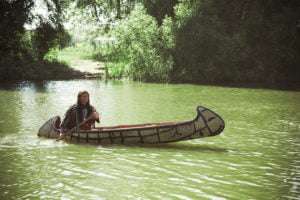
North American Indians use smaller canoes when paddling inland, while the brigades use freight canoes to carry 3 tons of cargo..
Monday 24th June ~ Left the Prairie des vases and crossed a large Bay of Lake Nipising. … I have been informed it is so shallow that they spear fish in winter in the middle of it under the Ice not exceeding 3-4 fathoms; its water is of a Grayish muddy colour. About the center of this lake is point aux Croix on which is erected the crosses of 11 men who were swallowed up, canoe & Cargoe, some years ago. Three leagues beyond this point we met an Indian and two little girls in a small birch bark canoe to whom we gave some biscuit in exchange for fish. …
[Finally they will travel downstream on the French River!]
~ At the chaudiere des Français, we carry from the Lake nipising to a deep stillwater cove of the River des Français, which issues out of the Lake by a variety of channels to the North North West of the portage and are too rapidious to be navigable above, if they are to be judged by the one nearest … which is steeper than a mill race and not wider in places. After proceeding about 2 miles down the cove where we carried from Lac Nipising the current of the main body of the Français River comming from the N.N.E. took us broad side and carried us down merrily being the first current able to make an impression on the canoe that we have drifted with. … At the Chaudiere des Français I saw the first Juniper berry growing but now they are to be met with all along the French River.
June 26th ~ Came down the following Rapids: Les Pins, Rapide Croche, La Fausille, Le Parisien, petit parisien. The day is a beautiful clear day and sun shine. Have seen nothing but rocks since we entered the French River, producing moss and some ever-greens stinted in growth, one would think that a bird could scarcely live on these

To stay in control while traveling downstream on the French River, the brigade must paddle double-time. They might finish the 75-mile river in one day, if they are lucky.
Rocks.
~ Fourteen leagues from here is L’Enfant perdu. … where according to the Story an Indian child that was bathing in sight of his parents was suddenly pulled under water and not coming up son his friends repeatedly dived for him, but to no purpose. Some time after they heard moaning under the ground … and began to dig with sticks and paddles and only gave up their attempts as vain when they heard the cries of the child proceeding under the high rocky ground and wood back of their encampment. It is said the Boy’s cries were heard for 6 days. …
~ A league below is the Grand Recolet Portage. One of the North West Companys canoes manned by the Majeau brothers was upset and lost half the cargo about 15 days ago. The few survivors and the goods that floated were picked up below the Rapid by the other canoes of the Brigade. These unfortunate men had made portage and loaded the canoe below it, but had neglected to put a man or two on shore with a bit of Line to stem the strong eddy which carries back to falls, from a foolish confidence in their own power, and in consequence were drawn down by the eddy under the pitch of the fall where the canoe instantly filled and sunk. … Though some of the bodies were found far below this the 7 crosses are erected here as a warning to others along with 7 others in memory of former casualties….

Macdonell noticed petroglyphs on the French River.
~ Derreaud’s Rapid, named for a voyageur who broke his Canoe in it. … There are various figures of animals &etc. made on the face of the steep Rocks in many places along the banks. Some leagues below Derreaud’s Rapid is the figure of a man standing over an animal that lays under him, with a sun on one side and a moon on the other each surrounded by a large circle—a little farthur on is at least 16 figures of different animals standing promiscuously together on the face of a steep Rock. Amongst them may be seen fish, flesh, and Tortoise, all of them painted with some kind of Red Paint. These figures are made by scratching the Rock weed [moss] off the Rocks with the Point of a knife or some other instrument.Two leagues from Lake Huron is the figure of an ox, which gives name to a fine long View of the river, Lac du Boeuf.
~ After passing a narrow Racy rapid named the Dalles we saw an Island … the Irroquois about 40-50 Years ago tried to cut off a strong Brigade of trading canoes. But upon finding themselves discovered by the French, they abandoned their ambush … and the canoes pursued their rout. It is said this was amongst the last attempts the Irroquois made in the long wars they had with the french in Canada. I think it strange that the Irroquois should have come so far out of their own territories to wadge war; …
Thursday, June 27th ~ After coming 25 leagues yesterday and today, which is, the full length of the French River … We entered [Lake Huron] with a very strong head wind which compelled us to put ashore as soon as we found a suitable place to unload and haul up the canoes. The French River enters the Lake by a great number of branches separated by high rocky Islands. The lake appears like an Ocean no land to be seen but that of the side we are upon. … There are a few rocky shoals where natives find water fowls eggs in the season; baskets full which they brought to our tents for sale, and tried all the ways they could devise to make us give them Rum but finding us staunch in our refusal offered to appease the wind if they could be indulged with something to drink …they departed much disatisfied, vowing they would conjure and cause the wind to blow with increased violence from the same quarter for 8 days.

Waves crash as the horizon opens up on Lake Huron.
~ From Lachine to Lake Huron there are 36 portages and an eaqual number of Décharges. … [Their guide lists them in order.]
~ … we lightened the guide’s canoe by 45 peices [three-fourths of the cargo] which were distributed them among the other canoes and shipped all my effects and those of Archibald McLeod and Lemoine, and took a man out of each of the other canoes, which made us a crew of 14 paddles and set out. … We set out on our journey leaving the rest of the brigade to wait the arrival of Dannis our associate guide whom we have not seen since the Long Sault. We are now but a single canoe making the best of our way to Grand Portage. [They have formed an express canoe to speed themselves to the rendezvous.] After proceeding 4 leagues, we put on shore for the evening.
The 28th ~ Being a fine sunshiny day we made good progress — next day we had a thick fog in which we were bewildered for some hours and camped at the serpents point — halfway to Sault [Ste. Mary].
Saturday 29th ~ Met a number of canoes coming from Michilimackinac and passed point Tessalon. We continue coasting the North shore of the lake.
Source:
“Five Fur Traders of the Northwest,” edited by C.M. Gates. Minnesota Historical Society (St. Paul, Minnesota, 1965).
- The featured image is “Canoes in a Fog, Lake Superior,” painted by Francis Anne Hopkins in 1869.
Final Thoughts
Read about how another newbie — my character Andre — experienced this journey, in Book 1, “Waters Like the Sky”
Book 2, “Treacherous Waters” and
Book 3 “Uncharted Waters”
Subscribe to this blog and read posts as they are published!
For what I’m researching or quirky discoveries, visit me on Facebook or Instagram (@nlnlnraj): I love your comments.
Book me as a speaker. (Send me a note through Contact Me to learn about the topics I’m working on.)
Ask your library, local school, gift shop to buy copies.
Be a voyageur for an hour — come to one of my presentations.
Consider writing your own chapter (fan fiction) about what else could happen.

