
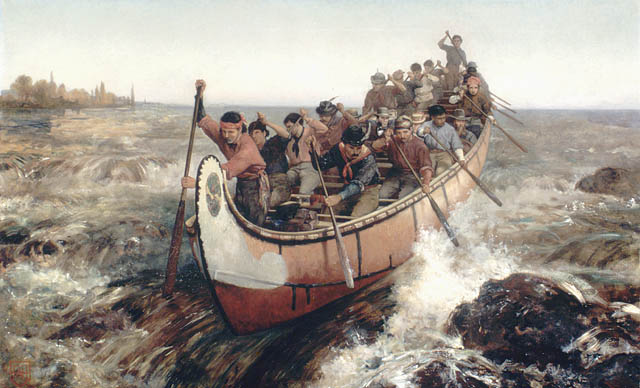
In 1793 John Macdonell left Lachine to serve as a clerk for the North West Company — and he kept a journal! While he commented on the trek up to Lake Winipic, I’m focusing on the first half of his journal — when his brigade left the Montreal area to their arrival at the rendezvous. Even so, I shortened his writings, to give a sense of the voyageurs’ work and his experience. [My notes are in italics, but the spelling and capitalization are his.]
As a clerk,with a 5-7 year apprenticeship, Macdonell didn’t have to paddle or portage on the voyage. When his brigade arrives at their wintering post by mid-October, he will supervise and be in charge of its trading.
***

This is a typical voyageur contract.
May 10 ~ Signed my engagement papers with the North West Company for five years to winter in the Indian Country as a clerk. The terms are £100 at the expiration, and found in necessaries. [That’s £20 per year. As “necessaries,” clerks were allotted tea, sugar and liquor, extra clothing, extra blankets, travelling equipment and a tent. He will get paid the cash upon return.]
May 25 ~ Embarked at Lachine on board a Birch Bark canoe, the first that I remember to have been in — my foreman’s name is Joseph La Tourelle and my steer’s-man Pierre Valois… The brigade of canoes in the Grand River [Ottawa] is generally 4. Canoes when fully loaded carry about 3 Tuns. [His steersman, foreman and the canoe’s 8-10 paddlers all come from the parish of Berthier. His guide was swapped out at the last minute and became Francois Huneau when the bourgeois picked Jos. Faignan for himself.]
May 27 ~ At nine A.M. Crossed over to St. Anns where we found the Priest saying mass for one Lalonde who had been drowned 110 leagues above this place; I.E. above this place, at Roche capitaine.
[A league is how far a man can walk in one hour, perhaps three miles; Roche Capitaine is a series of rapids in the Ottawa River below the forks at Mattawa].

Alms or donations collecting box
Tho drowned near twelve months ago, his remains were only brought down by his brothers this spring on their return from the upper country in a coffin made for the purpose in order to give him Christian Sepulture, according to the Catholic Rites. At the church of St Anns the crews of the Canoes collected a voluntary donation amongst themselves to which I contributed my mite, in order to have prayers said for the prosperity of the voyage and a safe return to those engaged in it, to thier friends and families; and here we left two of the canoes to wait for Mr. A(rchibald) N. McLeod, who is to be my fellow traveller …
[At St. Ann’s, crews normally left small donations but this traditional stop at the chapel became unusual because of the burial of one of their former mates. The brigade will camp at the Indian village on the Lake of Two Mountains for one night.]

The canoe bow shows gum over the wattap stitching.
May 28 ~ The guide & I went accross to the Indian Village for a supply of bark, gum, and wattap to mend our canoes in case of need. …We slept that night at the foot of petites Ecors, Carrillon Rapids, opposite Pointe Fortune. At petites Ecors, the river was confined between steep banks. [Gum, bark and wattap are canoe supplies. Gum was made by boiling the pitch from pine trees and pressed along the seams. When it hardened, it made the seams watertight. Wattap—either spruce or hemlock root—was used to sew pieces of bark together. Carillon, Point Fortune and Chute a Blondeau are modern towns that still bear the names used several centuries ago for landmarks on the river.]
May 29 ~ Slept at the chute a Blondeau.

From right, Lachine (where green meets orange), Ste. Anne’s (where pink island meets orange), the Lake of Two Mountains (where pink and green get close) and the beginning of the Long Sault (pink and green touch, at far left).
May 30 ~ Walked up the Long-sault [rapids] which the men call three leagues long. In it they made three portages and we slept two nights at the head of the third, where I saw the first cross or grave mark. I am told it is that of a young Christian Indian who was drowned in attempting to run the Rapid in his canoe. [At the Long Sault, in 1660, Adam Dollard and his followers died resisting an attack by Iroquois.]
The reason for our staying two nights at this place was to await the arrival of our associate brigade, conducted by an old guide named Denis who we find broke one of his Canoes and is gone back to the village of the Lake of the two mountains either to get another or materials to repair the broken one. The guide’s orders being to wait for the associate Brigade, we are likely to lose much time on the road.
[Part 1 ends as the month of May ends. My subsequent posts include Macdonell’s entries until he arrives at the rendezvous, in early July. ]
Source:

“Five Fur Traders of the Northwest” edited by C.M. Gates. Minnesota Historical Society Press (St. Paul, Minnesota, 1965). Macdonell’s diary is the second account of the five.
The featured image is “Shooting the Rapids” by Francis Anne Hopkins, painted in 1879.
Final Thoughts
Read about the journey through the eyes of another newbie, Andre, in Book 1, “Waters Like the Sky”
Book 2, “Treacherous Waters” and
Book 3 “Uncharted Waters”
Subscribe to this blog and read posts as they are published!
For what I’m researching or quirky discoveries, visit me on Facebook or Instagram (@nlnlnraj): I love your comments.
Book me as a speaker. (Send me a note through Contact Me to learn about the topics I’m working on.)
Ask your library, local school, gift shop to buy copies.
Be a voyageur for an hour — come to one of my presentations.
Consider writing your own chapter (fan fiction) about what else could happen.


I arrange speaking engagements for our American French Genealogical Society located in northern Rhode Island. Do you ever travel to New England for speaking presentations?
Wow! Thanks for asking. I haven’t gone that far afield yet, and would want to organize a number of events to make it work out. More later.