

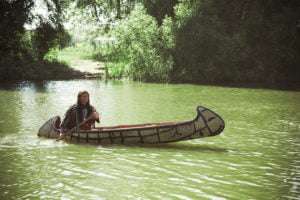
North American Indians used much smaller canoes than the fur trade brigades.
Imagine traveling hundreds of miles from winding rivers and rapids to vast inland lakes, carrying everything you need in a vessel made entirely from bark, roots and wood — a birch bark canoe. They were genius — objects deceptively simple, yet perfectly engineered by Indigenous builders, designed to balance strength, lightness, durability and portability, and capable of carrying people and cargo across thousands of miles.
The more I read, the more remarkable these canoes become.
Here’s Timothy Kent’s intro:

Volume 1 of a 2-book set
“The birchbark canoe was the most efficient watercraft for long distance cargo transport on these liquid highways, which varied from narrow, shallow rivers to churning rapids to huge lakes the size of sea. Cargo transportation on these routes required a craft with a great load capacity yet shallow draft, much strength and durability yet light weight for easy portaging, and speed and ease of paddling and handling. The birchbark canoe, developed and highly refined by numerous native groups in the prehistoric era, possessed all of these attributes. In addition, it could be built and repaired using materials which were often found in the forests along the routes, with minimal tools.”
~ Timothy J. Kent: “Birchbark Canoes of the Fur Trade”
I’m more familiar with voyageur brigades of massive Montreal canoes, but they were used for military expeditions, by missionaries, for mail and message delivery and even as gifts to allies. Kent details how early canoes were constructed, different hull designs and sizes used by various tribes or for different needs, how canoes developed over time … He’s an incredible resource!
Martin Auger, Alberta, Canada

Martin Auger prepares materials to make a birch bark canoe in the old manner. (Photo by Eleanor Toshiko Hyodo for “The Beaver,” Summer 1973)
My focus on canoe construction re-ignited when Greg Ingram, re-enactor and collector of fur trade memorabilia, sent me an amazing article — “On Building a Birch-Bark Canoe,” copied from the online “The Beaver,” Summer 1973.
It tells of Martin Auger, 70, a Cree constructing a canoe in the old manner, observed by the writer, Albert Burger. Diagrams of different sections of the canoe and photos clarify the text. [To access other articles in Canada’s History Archive, type in the search box.]
Martin was as exacting about the birch trees he selected for the canoe’s exterior as he was about the black spruces and willows that provided structure, shape and strength. Tackling each step by hand, he first shaped a beam and split it into “Oh, many” slats — about 65 slats of 2 ½ inches wide and ¼ inch thick! He next formed the frame and prepared the inner and outer gunwales, the ribs and stem ends —they required time to dry into their needed curve.
To split white spruce root — the best sewing material (wattap) — Martin carefully used his teeth, instead of a knife. He joked that, because of his advancing age (with fewer teeth left), he was not as adept as he once was.

Note the stitching of wattap on the prow of this canoe at the Snake River Fur Post, Pine City, Minnesota.
He staked out the canoe’s dimensions on the ground and laid his birch bark sheets, weighted by rocks. The now-dried gunwales he placed atop the birch bark and then the thwarts, tying them to form the canoe shape and placing the centerboard, the bow and stern pieces.
Martin’s wife, Marie, helped him with the sewing, as they needed to finish quickly to prevent the bark from drying and cracking.
To prepare spruce pitch to gum the seams, Martin described an old process: pitch was gathered like maple sap, taking up to 4 years for pails to fill. Sap was placed in a basket of root netting before tossing it into a container of boiling water — the netting trapped impurities as the boiling water melted the pitch. After cooling and reheating it, Martin added lard, making it less likely to crack, before applying the mixture over the stitching and leak-prone areas.
Completing his canoe and a pair of paddles took Martin about 5 weeks of leisurely work.
Bill Hafeman, Bigfork, Minnesota

This 24-page booklet is available at the Itasca County Historical Society (To order, see Sources, below).
In the 1920s, Bill Hafeman taught himself to build authentic birch bark canoes. His story is told in a booklet, “Builder of Birch Bark Canoes.”
Living along the Bigfork River in northern Minnesota, Hafeman regularly built cedar strip boats. His long-time dream? Making Indian and voyageur canoes. With no one to teach him and no models to inspect, he used what was available, working from memory of his childhood. He tried elm bark for his first canoe and found it usable, but heavy and cumbersome. He realized any tree could be used, but birch bark’s lightness and durability made it most practical. At one time, Hafeman was the only non-Native man to build canoes in the Indian fashion — he created the canoe featured in the Minnesota Historical Society Museum’s fur trade exhibit in St. Paul as well as other historic locations.
Though I grew up only a few miles away from Hafeman, I learned in adulthood that Bob Davis, my elementary school classmate, was Hafeman’s great-nephew. Bob occasionally dug the spruce roots (wattap), needed to sew the gunwales and ends of the canoe.

Note how the pitch sealing the seams melted on this old canoe at Snake River Fur Post, Pine City, Minnesota.
Hafeman’s single concession to modern times — seal seams with asphalt. He found that spruce pitch needed to be replaced often because it cracked and, on hot summer days, melted.
YouTube has a 1970 film of Hafeman as he builds a canoe. Look for “The Birch Canoe Builder.”
Ray Boessel, husband of a granddaughter, continues the boatworks business, building historically accurate birch bark canoes–and shares his story in another YouTube video.
Carl Gawboy. Ojibwe artist and author
 In his pictorial book, “Fur Trade Nation: An Ojibwe’s Graphic History,” Carl Gawboy shows the difference in sizes, that the shape of a canoe is based on the direction of the grain of birchbark. While men did the woodwork that framed the canoe body, women sewed and gummed the canoes. In a type of construction called “skin-first,” the covering was shaped by skilled women who sewed. His drawings and commentary on the process of canoe-building clarify the steps in a delightful manner.
And something I hadn’t realized: Gores, which crimped the birch bark by the gunnels (gunwales), then raised the ends to create a “rocker bottom” — to stabilize the canoe!
[I plan a review on Gawboy’s book as soon as I can limit my comments to a blog-length post.]
The birch bark canoe was an engineering marvel of skill and efficiency — light, strong, repairable with materials from the forest, developed by Indigenous builders. Canoes carried thousands of people and tons of cargo over thousands of miles on “liquid highways.”
Need an en route repair? A roll of birch bark, spruce root and a container of spruce pitch will do it.
Final Thoughts
 What would it be like to discover this country as a youth, with a brigade of voyageurs? Start from the beginning with Books 1 and 2 — “Waters Like the Sky” and “Treacherous Waters” as Andre struggles with disasters as he learns the fur trade business. In Book 3, “Uncharted Waters” he pilots a single canoe with a unique “cargo” — a dangerous mission to paddle by themselves.
 - Subscribe to this blog and read posts as they are published!
- For what I’m researching or quirky discovers, visit me on Facebook or Instagram: @nlnlnraj. I love your comments.
- Book me as a speaker.
- Ask your library, local school, gift shop to buy copies.
- Be a voyageur for an hour—come to one of my presentations: Upcoming is the Old Wadena Society April 14.
- Consider writing your own chapter—fan fiction—about what else could happen.
Sources:
- “Birchbark Canoes of the Fur Trade, Volume 1” by Timothy J. Kent. Silver Fox Enterprises (Ossineke, Michigan), 1997.
- “Builder of Birch Bark Canoes” by William Rossman. Grand Rapids Herald Review (Grand Rapids, Minnesota). Copies are available for $5 (includes shipping) through Itasca Historical Society, 201 Pokegama Ave. N., Grand Rapids, Minnesota 55744; (218-326-6431).
- “Fur Trade Nation: An Ojibwe’s Graphic History” written and illustrated by Carl Gawboy (AnimikiiMazina’iganan: Thunderbird Press, Cloquet, Minnesota), 2025.
- Canadian Canoe Museum (Peterborough, Ontario, Canada)
- “On Building a Birch-Bark Canoe,” article by Albert Berger in “The Beaver,” Summer 1973
Currently reading:
- “Buffalo Shout, Salmon Cry: Conversations on Creation, Land Justice, and Life Together” edited by Steve Heinrichs. Herald Press (Kirchener, Ontario), 2013.
- “Fur Trade Nation: An Ojibwe’s Graphic History” written and illustrated by Carl Gawboy (AnimikiiMazina’iganan: Thunderbird Press, Cloquet, Minnesota), 2025.
ANY video available?
https://nikkirajala.com/uncharted-waters/
Book 3 ebook link: https://www.amazon.com/Uncharted-Waters-Nikki-Rajala-ebook/dp/B0DCXFXM5V/ref=tmm_kin_swatch_0?_encoding=UTF8&qid=&sr=
https://nikkirajala.com/waters-like-the-sky/
https://nikkirajala.com/treacherous-waters/
Or the ebook: https://www.amazon.com/gp/product/B07F7PB99W/ref=dbs_a_def_rwt_bibl_vppi_i1
https://nikkirajala.com/voyageurs-life-blog/
https://www.facebook.com/NikkiRajalaAuthor/?ref=bookmarks
Insta: @nlnlnraj
https://nikkirajala.com/contact/

