

 When my sisters visited Canada a few years ago, they presented me with this gift card from the flagship Hudson’s Bay Company store. HBC was founded in 1670, first serving the fur trade and later the public with fascinating department stores I loved the trademark stripes — and carrying this card around.
Unfortunately, after 355 years of being the longest-operating business in North America, HBC closed its doors Jan. 1, 2026. What a loss for us all.
The old way to purchase
Pay-as-you-buy was the prevailing system of commerce for centuries all over the world. Going into any shop, even with cash in hand, buyers might hear: “Sorry that’s not enough money for this beaver hat, medicine, silk frock, Chinese tea, … model T …. ”
 Originally, indigenous trappers had only one place to trade their furs — at a fort located far away on Hudson Bay. That “big-box-store” model was reflected in the fur trade from the 1600s through the mid-1700s.
Credit — try it first, pay later
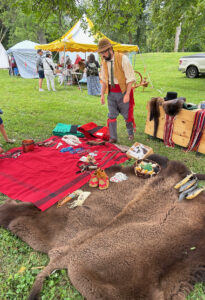
Brian Handy begins setting out his trade goods at the rendezvous in Huot, Minnesota.
The North West Company changed all that. First, they brought goods into the interior of the continent, right where the tribes lived. In late autumn, to begin the trading season, traders displayed guns, copper pots, metal tools like iron fishhooks, awls, chisels, traps and knives, woolen blankets and cotton fabrics, beads, needles and thread. Often, traders gave gifts — like beads, fish hooks, tobacco and alcohol.
After they taught the intricacies of using a trade gun, traders might offer it to the purchaser to use it all winter, to harvest more pelts to “pay” for it (firearms being the most expensive item they carried). Traders extended credit to their customers.
Now, instead of a storekeeper holding all the power, as in the old method of commerce, trappers and hunters could “charge” it to their account and settle up at the end of the trapping season.
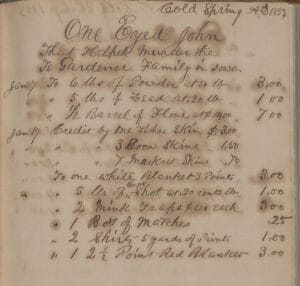
The ledger for One-Eyed John, kept by AC Riggs in 1854. Riggs likely didn’t know the man by his name.
Traders identified each tribesman in a ledger (a form of promissory note) along with the goods they took debt for. Over the winter, the trappers paid them back with pelts (which were thicker, and more valuable in winter) and by providing food and services for the voyageurs.
If hunters or trappers couldn’t harvest enough pelts to pay off their debt, traders could carry over the balance to another year — assuming the fur post stayed at the same location. (Some fur posts moved around every year!) Towards the end of the era, more often trappers owed traders than the reverse.
And so ushered in the new model. NWC competed directly with HBC. As NWC coffers rose, HBC took notice.

Ledger tracks “purchases” at Snake River Fur Post in Pine City, Minnesota
Keeping track
Keeping track could be complicated for tribes who didn’t trust/understand “talking books” to keep track of their debt. Their memory had to agree with what the trader wrote, which they couldn’t decipher, and they had to honor his system.
To indicate what pelts were brought in, traders who weren’t literate might use symbols for a “made beaver,” the standard and most valuable of the furs. According to Wikipedia, a made beaver could be “represented by a stick, a porcupine quill, a whale or walrus ivory disc, a musket ball, or anything else agreed upon by the trader and trapper. The trapper would be handed a number of units agreed upon — representing the value of his catch — and with these would make his purchases from the store.”
Natives liked the blankets and fabrics, but discovered that guns had disadvantages, while traders figured out that one-and-done purchases didn’t earn the money that consumable goods did. Shot, powder and other gun needs made up that difference.
How about trading coins?
Late in the era, the Hudson’s Bay Company minted brass trading tokens, designed by George Simpson McTavish of Albany Fort in 1854. This was a handy proof if a trader owed a trapper.
- The largest coin was equal to the pelt of one adult male “Made Beaver.”
- Coins of 1/2 were used for foxes and “woodchocks.”
- Coins of 1/4 were traded for “pappecotes” [bobcats], “raccoones,” “martins” and large “seil skins.”
- Coins of 1/8 were for “mincks.” (Eight small pelts equaled one Made Beaver.)
- These trading tokens could be given when hunters brought in furs but didn’t choose goods. They were light to carry around and could be used at any HBC post. How innovative!

Hudson’s Bay Company brass tokens, used circa 1854 in trading posts in the Eastmain district. From left are coins representing Made Beaver [pelts] or fractions: Front side and reverse side of 1, 1/2, 1/4 and 1/8. (From the personal collection of Jim Trethewey. Photo courtesy of Wiki Commons)
Credit problems
You might believe that tribesmen failed to honor their debts. They never had bargaining power in the cost of the trader’s goods or the value of their furs (while the company partners got fabulously rich).
Actually, getting the tribes to overextend themselves was intentional. Thomas Jefferson wrote this in1802, a letter to Indiana Territorial Gov. William Henry Harrison: “To promote this disposition to exchange lands, we shall push our trading houses and be glad to run up debt because when these debts get beyond what the Indian can pay, they will become willing to lop them off by a cessation of lands.” 
Indians couldn’t deliver the number of pelts they’d promised and were urged to over-trap streams, decimating animal populations. At the same time they were facing death by disease and addiction to liquor, two aspects no one expected, but both were used against them. It was disastrous for them.
Credit ruined Anglo lives as well. In the 1980s, it was so easy to obtain credit cards that people sank under ruinous interest rates and mushrooming debt.
Ironically, HBC found itself over-extended and was forced to liquidate.
But credit remains, with different rules. And now we have debit cards, reloadable credit cards, crypto, Venmo and more. What next??
Final Thoughts
- Read my novels from a newbie’s view of the fur trade: Book 1: “Waters Like the Sky” Book 2: “Treacherous Waters” and Book 3: “Uncharted Waters” all in paper and ebook form.
- Subscribe to this blog and read posts as they are published!
- For what I’m researching or quirky discoveries, visit me on Facebook or Instagram (@nlnlnraj): I love your comments.
- Book me as a speaker.
- Ask your library, local school, gift shop to buy copies.
- Be a voyageur for an hour — come to one of my presentations.
What I’m reading
“Finding the Mother Tree: Discovering the Wisdom of the Forest” by Suzanne Simard. Vintage Books, division of Penguin Random House (New York, 2021)
“George Drouillard: Hunter and Interpreter for Lewis and Clark & Fur Trader, 1807-1810” by M.O. Skarsten. University of Nebraska Press (Lincoln, Nebraska, and London, 2005).
“Hanta Yo: An American Saga” by Ruth Beebe Hill. Doubleday & Co. (Garden City, New York, 1979)
“The Sound the Stars Make Rushing Through the Sky: The Writings of Jane Johnston Schoolcraft” edited by Robert Dale Parker. University of Pennsylvania Press. Philadelphia, Pennsylvania, 2007).


Love this, Nikki! So much interesting information. Good work.
Thanks a lot. I keep finding great stuff. Poor Bill–every night while he’s reading, I say “Bill, listen to this…” and tell him some surprising fact. Most of them found their way into the story!